Final Youth Webinar Overview
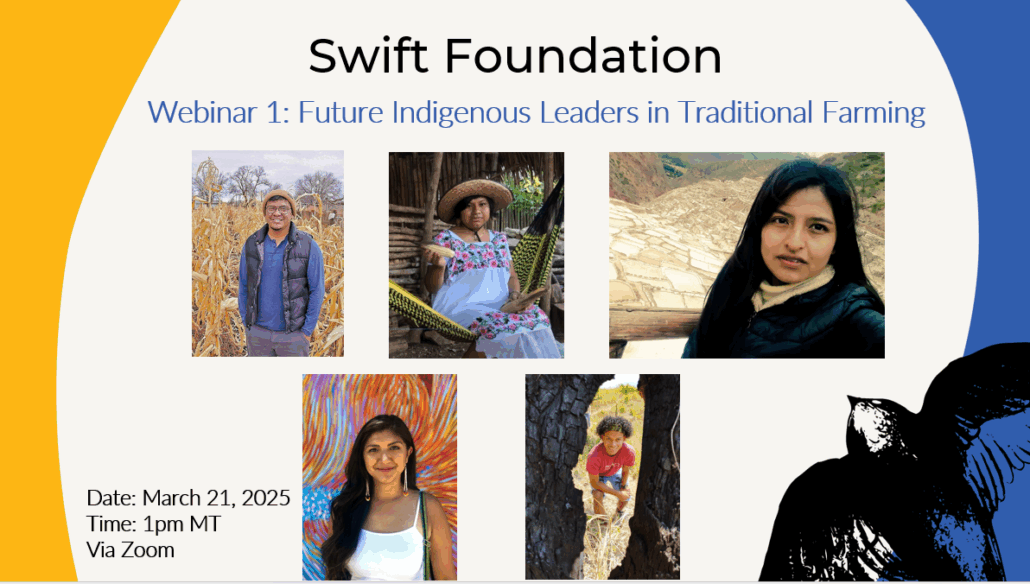
Preserving biodiversity, promoting sustainable farming techniques, and ensuring community sustainability are cornerstones of Indigenous agricultural practices, deeply rooted in generations of traditional knowledge. A recent Swift Foundation webinar, the second in a series developed to highlight Indigenous People’s longstanding fortitude, values, and wisdom, cast bright sunlight on the increasing relevance these practices have in today’s ecologically challenged, destructive, and destabilized world. By recognizing and engaging with a new generation of Indigenous leaders, the webinar celebrates efforts to preserve Native food sources, seeds, gardening and harvesting tools and techniques; medicinal plant knowledge; and ancestral healing and birthing practices. Collectively, these approaches stem from, and honor, intergenerational wisdom that has been passed along by Indigenous knowledge keepers for centuries.
The June 4, 2025, webinar was moderated by Swift Foundation Executive Director Suzanne Benally, a member of the Navajo Nation with a 45-year distinguished career in philanthropy, cultural preservation, and higher education. Spanish language translation was provided by Cassandra Smith. Alejandro Argumendo, an Indigenous Quechua man from central Peru and Swift’s director of Programs and Amazon lead, gave closing remarks. The five dynamic panelists represent communities from two Pueblo tribes in New Mexico (United States), the Yucatan Peninsula in Mexico, and Indigenous groups in Columbia and Peru. Their captivating messages and photos describe time-honored Indigenous techniques that foster local ecosystem preservation and empower communities to collectively thrive sustainably for centuries.
The panelists include:
- Diné farmer Graham Beyale of the Hooghan Łání clan. He is a seed keeper who tends his family’s four-acre organic farm in the San Juan River Valley near Shiprock, New Mexico, on the Navajo Nation in the US. He also operates the Biyáál Trading Post in Shiprock and its online component, Biyáál Trading Post, that sells Native teas, seeds, corn, cornmeal, beans, squash, melons, farm products, and artwork.
- Ana del Carmen Poot Cahum, an Indigenous Mayan woman from the community of Tihosuco, Quintana Roo, Mexico. She is a member of the International Network of Youth of Community Agroecology (RIAC), and the Múuch Xíinbal assembly in the Yucatán Peninsula. As an engaged campesina she facilitates workshops for youth on topics such as planting native seeds, agroecological practices, and native bee stewardship while advocating for the sovereign rights of her ancestors and Indigenous communities.
- Engracia Marina Chávez Puma, who from a young age felt called by the land and the responsibility to protect the centuries-long diversity of native corn that has been the sustenance and identity of her Choquecancha community within the Chalakuy Park deep in the Peruvian Andes. She utilizes the training in Agricultural Sciences she received at the National University of San Antonio Abad del Cusco, combined with ancestral wisdom, cultural richness and spiritual depth gained from her community and its deep connection with the land to advocate for the conservation of biodiversity and the sustainable management of natural resources.
- Chasity Salvador is a young farmer and traditional seed keeper growing food for her family and the Pueblo of Acoma in New Mexico (US). She is also a full-spectrum doula, Indigenous breastfeeding counselor and birthkeeper providing birth work services, traditional midwifery, and massage therapy in her community, utilizing foundational medicinal plant knowledge to aid new mothers and critically ill community members. She is a scholar, writer, and organizer on Pueblo women in agriculture, Indigenous food and seed sovereignty, and how Indigenous communities can navigate the climate crisis.
- Eider Vega Torres, a campesino, divides his time between his community and the city of Cartagena, Columbia, where he has studied for the past two years visual arts including photography and filmmaking. He describes having to leave his community to go to school in the city as complicated. Nonetheless, he manages to farm while studying by spending every weekend back in Montes de Maria, where he continues to work the land with his father. Empowered by his study of visual arts, Eider has worked with other young people to document and tell the stories of their own Indigenous community food systems, recipes, and traditional farming practices
Zoom Recording – Future Indigenous Leaders in Traditional Farming
Coming soon!